The end of the financial year is a critical milestone for any company. It represents the result of a full year of operations and financial activity. This stage, often known as the financial close or year end closing, goes beyond a routine administrative task. It is a core process that provides a clear and accurate view of a company’s financial position, performance, and overall standing during the past year.
A successful financial close is essential for meeting regulatory requirements, ensuring proper tax preparation, and laying the foundation for strategic planning in the new year.
This comprehensive guide brings together best practices and key steps for the year end closing process. It is designed to help you complete the close smoothly, prepare for audits, and move into the new financial period with confidence.
The Strategic Importance of Financial Year Closing
The financial year closing process includes reviewing all financial transactions, reconciling them, and verifying their accuracy in order to prepare the final financial statements. This careful process is not limited to accounting tasks only. It also serves several strategic purposes, including the following:
- Performance evaluation
Final financial statements such as the balance sheet, income statement, and cash flow statement allow management to assess whether the company has achieved its financial goals. They also help identify strengths and areas for improvement.
- Stakeholder reporting
Accurate financial reports are essential for transparency with investors, shareholders, lenders, and other external parties. This transparency helps them make informed decisions about the company.
- Tax and compliance
Year end closing provides the required documents for filing annual tax returns and meeting all legal and regulatory requirements. This ensures the company remains financially compliant.
- Audit readiness
A properly executed financial close reduces discrepancies and errors. It also ensures that financial records are well prepared for any potential external audit.
Common Challenges in Financial Year Closing
Despite the strategic importance of financial year closing, this phase is often one of the most stressful periods for finance teams. The high volume of transactions and the need to coordinate across multiple departments frequently expose weaknesses in financial processes.
A deep understanding of these challenges is an essential step toward reducing delays, minimizing errors, and ensuring a smooth and accurate financial close that reflects the company’s true financial position.
1.Missing or Incomplete Documents
Missing or incomplete documents and invoices are among the most common challenges during financial year closing. Employees may delay submitting receipts, invoices, or expense reports, or they may submit them without enough detail. This creates gaps in the accounting trail and forces accountants to pause reconciliation work while searching for missing information.
As deadlines approach, these delays tend to pile up. This increases the risk of rushed adjustments or accounting entries that are not properly supported by documentation.
Solution
Organizations can reduce this challenge by using automation tools that require documents to be attached at the time of the expense, instead of waiting until the end of the month or year. Clear communication about submission deadlines, along with standardized document requirements, ensures that complete and accurate records reach the finance team on time.
Read also: How does Nqoodlet provide you with real-time tracking of your financial position?
2.Human Errors
Manual accounting processes naturally rely on human effort, making them more prone to errors, especially during the financial year closing when transaction volumes are high and processes are more complex. Mistakes can occur in data entry, calculations, account classification, or recording journal entries. Even small errors can trigger a series of problems, such as unbalanced accounts, inaccurate financial statements, or the need to redo work during audits or reviews.
Solution
Reducing human errors requires a combination of organized review procedures and technology. Double-checking entries, reconciling balances, and implementing segregation of duties help detect errors early. More importantly, using modern accounting systems that provide automated calculations, validation rules, and clear audit trails significantly reduces mistakes and improves the accuracy of financial data.
3.Poor Communication
Financial year closing often reveals communication issues between the finance department and other departments. Accountants spend a lot of time following up with employees, procurement teams, or managers to clarify transactions, confirm expense purposes, or request missing approvals. This constant back-and-forth slows down the closing process and distracts from higher-value financial analysis.
Solution
Centralized expense management systems and clear internal workflows help reduce reliance on ad-hoc communication. When all transactions, approvals, and supporting documents are available in one system, finance teams can access the information quickly without repeatedly contacting other departments. Clearly defining responsibilities and setting expected response times also improves collaboration and speeds up the closing process.
Read also: How to develop an effective employee expense policy?
4.Lack of Planning
Many organizations approach financial year closing reactively, without a clear plan or schedule. The absence of a detailed closing calendar often leads to unclear responsibilities, overlapping tasks, and last-minute bottlenecks. This reactive approach increases pressure on teams, prolongs the closing process, and raises the risk of accounting errors or omissions.
Solution
Advance planning is crucial for a successful financial close. Creating a detailed closing calendar with clearly defined responsibilities and deadlines enhances accountability and allows effective progress tracking. Adopting a continuous close approach, where reconciliations and reviews are performed regularly throughout the year, significantly reduces the end-of-year workload and enables a faster, more controlled, and disciplined closing process.
Accounting Close Stages for Year End
To turn the year-end closing process from a stressful and overwhelming task into an organized and clear procedure, follow these four stages. This approach combines account reconciliations with the final closing entries.
Stage 1: Preparation and Document Collection
This stage focuses on organizing and verifying essential data, as it forms the foundation for the financial statements.
- Create a Detailed Closing Schedule
Set up a clear calendar that includes all important deadlines, such as the last date forsubmitting expenses, the general ledger closing date, and the final date for issuing financial reports. Assign a clear responsible person for each task to ensure accountability and timely completion. - Collect All Missing Documents
Ensure that all invoices, receipts, and expense reports for thefinancial year are received. Set a firm deadline for document submission and communicate to employees the importance of meeting it to ensure an accurate close. - Separate Personal and Company Expenses
Make sure no personal expenses are recorded in the company accounts. This is a fundamental accounting principle and is especially important for tax and regulatory compliance.
Read also: Avoid Letting Employees Use Personal Bank Cards For Your Business Expenses
- Review Supplier and Customer Data
Ensure that all supplier and customer information is up to date and accurate, including tax identification numbers and addresses. Accurate data is essential for preparing correct final reports and meeting compliance requirements.
Stage 2: Reconciliations and Adjustments
This is the most intensive stage, where all accounts are checked to ensure they accurately reflect the company’s true financial position.
- Reconcile All Cash Accounts
Match the general ledger balances for all bank accounts and credit cards with the corresponding bank statements. Any discrepancies should be analyzed and corrected using proper accounting adjustment entries.
- Reviewand Adjust Asset Accounts
- Inventory: Perform a physical inventory count (if using a periodic system) or review records in a perpetual inventory system. Then adjust the inventory account to reflect the actual value and accurately calculate the cost of goods sold (COGS).
- Fixed Assets: Record any assets purchased during the year and calculate annual depreciation according to the company’s accounting policy.
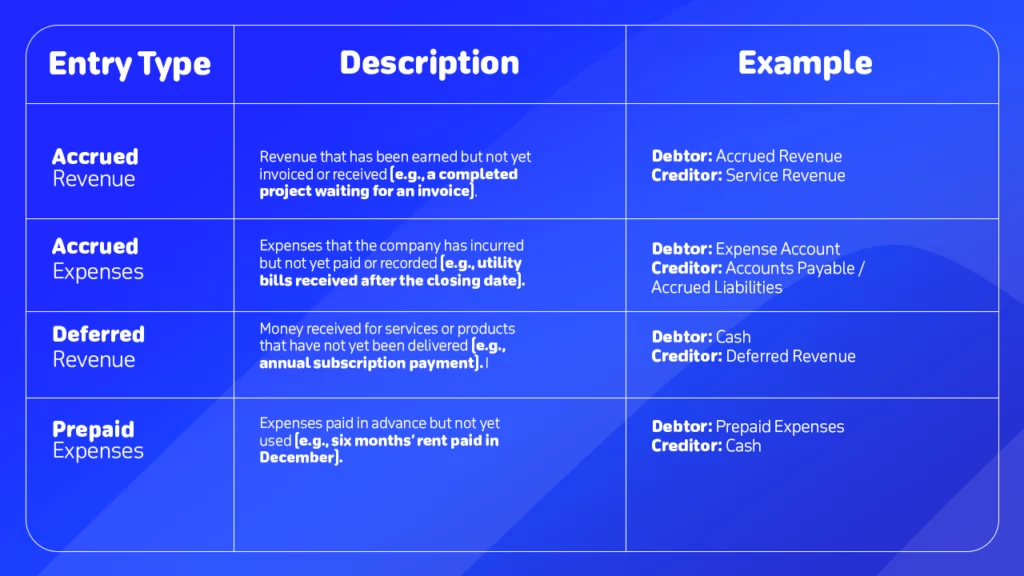
- Prepaid Expenses: Review prepaid accounts such as rent or insurance. Any portion not yet used should be carried forward as an asset into the new financial year, rather than being recorded as an expense in the current year.
- Reconcile Bank Loans and Interest
Reconcile all bank loan balances and ensure that recorded payments are correctlyallocated between principal repayment (reducing the liability) and interest expense (recorded in the income statement).
Stage 3: Closing Final Revenue and Expense Accounts
This stage focuses on ensuring that all revenue and expense transactions are correctly recorded for the current financial year, regardless of the timing of cash flows (accrual accounting).
- Close Accounts Receivable
Ensure that all earned revenue for the year is recorded, even if payment is delayed (accruedrevenue). This includes creating invoices and making accrual entries for unbilled revenue. - Close Accounts Payable
Record all expenses for the year, even if they have not yet been paid. This includes supplier invoices received at the last moment and recording accruals for any unpaid debts or services. - Adjust Government Grants and Entitlements
Calculate any government contributions, grants, or tax exemptions received during the year, ensuring they are properly classified and recorded.
Phase 4: Closing the Books (Closing Entries)
The final step in the year-end close is to reset all temporary accounts (revenues, expenses, and dividends/drawings) and transfer their balances to the permanent equity account (Retained Earnings).
This prepares the books for the start of the new fiscal year.
- Close Revenue Accounts:
- Debtor to all revenue accounts (to bring their balances to zero).
- Creditor to the Income Summary account.
- Close Expense Accounts:
- Creditor to all expense accounts (to bring their balances to zero).
- Debtor to the Income Summary account.
- Close the Income Summary Account:
- If the company has a net profit (revenues > expenses):
- Debtor to the Income Summary account.
- Creditor to Retained Earnings.
- If the company has a net loss (expenses > revenues):
- Creditor to the Income Summary account.
- Debtor to Retained Earnings.
- Close Dividends / Owner’s Drawings Account:
- Creditor to the dividends or owner’s drawings account (to bring the balance to zero).
- Debtor to Retained Earnings.
After posting these entries, the only accounts with balances will be the permanent accounts: assets, liabilities, and equity.
Ready to enhance your company’s financial operations? Contact us today to schedule a demo and discover how Nqoodlet can benefit your business