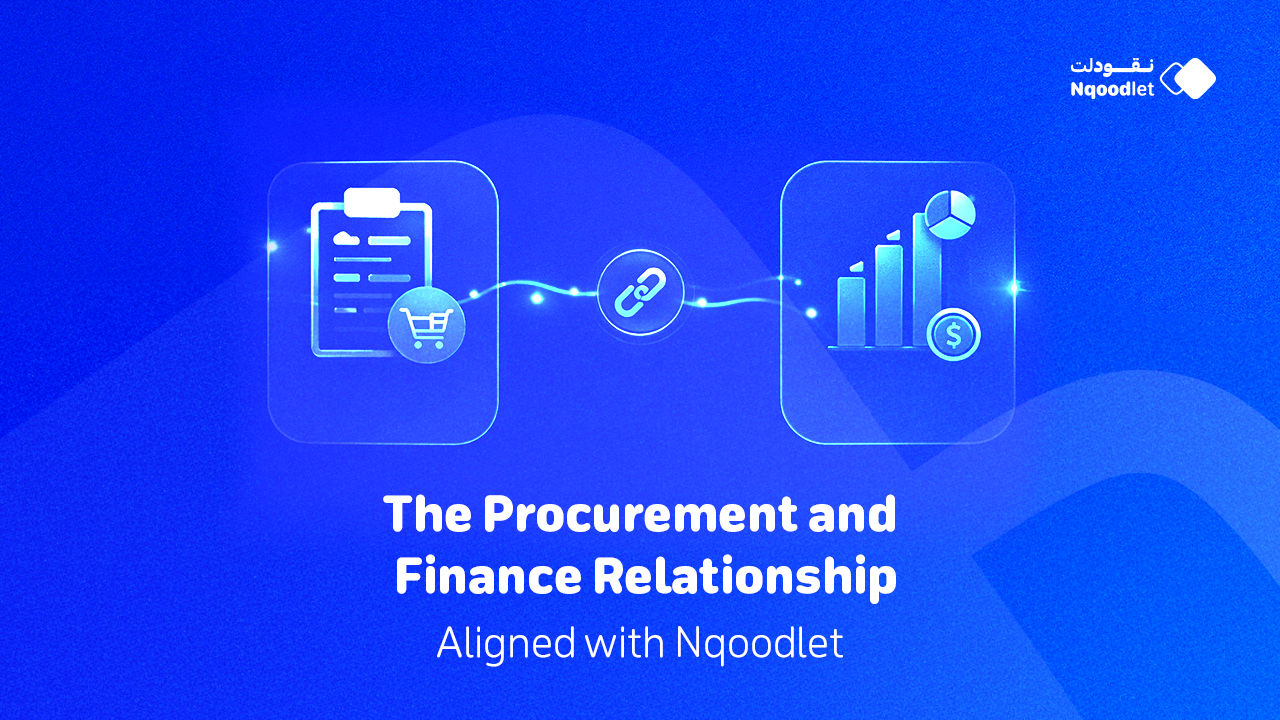
In most companies, money sits at the center of every decision. It’s where things start and where they end. The issue is that this flow is usually split between two teams. Procurement handles the buying, while finance keeps track and reviews.
When these two aren’t properly connected, things slow down. Daily tasks take longer, numbers don’t match, and leadership struggles to stay in control of spending in a real, practical way.
Companies that manage their expenses well aren’t the ones adding more rules. They’re the ones where procurement and finance operate on the same data, at the same time, with a shared understanding.
Before getting into how to connect them, it helps to first understand what each team is responsible for:
Procurement Management
The team that makes sure the company gets what it needs to keep running. They handle purchasing goods and services, choose the right suppliers, negotiate deals, and aim to get the best value for every cost.
Financial Management
Focuses on the company’s money. They plan budgets, track cash flow, review spending, and make sure the business stays financially stable by relying on clear, accurate numbers.
The Dilemma
In many companies, procurement and financial management operate as two separate tracks.
The Result: decisions don’t align, spending lacks clarity, and teams lose time trying to reconcile numbers after the fact.
Fixing this isn’t about adding more meetings or complicated processes. It comes down to clear roles and having data that moves instantly between both sides. Here are the key foundations that help procurement and finance work as one team:
Foundations for Building Integration Between Procurement and Financial Management
1. Linking the Budget to Purchasing Decisions
Having a budget does not mean you can spend freely, it means you have a framework that must be adhered to.
The problem in many companies is that the budget is set at the beginning of the year, then left without any real connection to daily purchasing decisions, causing expenditure to become a series of operations detached from financial planning.
Real alignment happens when every purchase request is treated as part of the bigger financial picture, not just a standalone action.
How is this alignment actually achieved?
Liquidity Availability
Not every amount allocated in the budget is actually available in the bank account. Before approving any purchase, the following must be known:
- Is there sufficient liquidity right now?
- Will this payment affect near-term obligations (salaries, suppliers, operational commitments)?
The question here is not “Does the budget allow it?” but rather “Does the current cash position allow it?”
The Impact of the Expenditure on the Overall Budget
Every purchase, even a small one, affects total spending. Without an updated view, teams may continue spending without realizing they are approaching the limit. Proper linkage ensures:
- Knowing what has been spent versus what was planned
- Anticipating what remains of the budget
- Detecting overruns before they occur, not after
Operational Priorities
Not all expenditures carry the same level of importance. In times of budget pressure, there must be a clear reference for prioritization:
- What directly impacts revenue?
- What can be deferred?
- What can be reduced or substituted?
Without this ordering, the budget becomes merely a number rather than a decision-making tool.
2. Availability of Information in Real Time
Sound decisions are not built on what happened a week or a month ago, but on what is happening now. When a company relies on delayed reports, management shifts into a reactive mode rather than maintaining control.
Having information available in real time means that every purchasing or financial approval decision is made based on an accurate and current picture of the financial situation, not on estimates or outdated data.
To achieve this, the following information must be immediately and continuously available:
Cost Estimates
Before executing any purchase, finance needs a clear view of the expected cost and how it compares to the available budget. Having these estimates in real time helps:
- Prevent budget overruns before they happen
- Quickly assess the feasibility of a decision
- Prioritize based on financial impact
Supplier Contracts
Payment terms, discounts, and contractual obligations directly affect cash flows. When these contracts are accessible and up to date:
- Payment errors are reduced
- Preferential terms are fully utilized
- Future negotiating power is strengthened
Invoice Status
Has the invoice been received? Has it been approved? Is it awaiting payment? The absence of this visibility leads to:
- Delayed settlements
- Duplicate payments
- Unexpected pressure on liquidity
Real-time clarity on invoice status gives the team the ability to:
- Track every invoice from issuance to settlement
- Accelerate the approval cycle
- Organize payments with greater precision
Payments
Knowing what has been paid, what is in progress, and what is due is essential for liquidity management. When payment data is current:
- Cash flows can be forecasted accurately
- Sudden liquidity shortfalls are avoided
- Financial decisions are made with greater confidence
3. Fast and Effective Financial Approvals
Financial approval should not be understood as a stage that disrupts operations, but as a mechanism that maintains spending balance and prevents arbitrary decisions. The problem arises when these approvals turn into a chain of messages and waiting periods, causing the team to lose agility without achieving genuine oversight.
The effectiveness of approvals begins with speed. A decision must be made at the moment it is needed, not days after a review cycle. The shorter the approval cycle, the more effectively teams can execute their work without disruption, while still adhering to the budget.
Speed alone, however, is not enough. Data clarity is what gives an approval its true value. When a request reaches the responsible party accompanied by all relevant details:
- The reason for the request
- The cost
- Its impact on the budget
- Available alternatives, if any
The decision becomes one grounded in full understanding, rather than a mere routine procedure.
Reducing manual steps is equally important. Every additional step, every transfer between systems or messages, opens a door to errors and delays. The more the approval process is tied to a single system that consolidates and presents data directly, the faster and more accurate the process becomes.
When these elements come together, approvals are transformed from an operational burden into a smart control mechanism: one that does not impede work, does not allow budget overruns, and gives management instant visibility into every decision being made.
4. Shared Responsibility for Cost Monitoring
Controlling expenditures cannot be the sole responsibility of the financial department, nor can procurement simply execute requests without considering their financial impact. In reality, every expenditure originates in procurement, but it is measured and assessed through finance, and it is between these two points that a company’s efficiency in resource management is determined.
When each department operates in isolation, a clear gap emerges: procurement views figures through the lens of operational need, while finance views them through the lens of budget and cash flows. This gap leads to decisions that may appear sound to each party individually, yet prove imprecise at the company level.
True integration begins when the data that procurement relies on is identical to the data that finance uses, with no discrepancy or delay. This means every purchase is recorded at the moment it occurs and is visible to both parties with the same level of detail: the value of the expenditure, the benefiting department, its timing, and its impact on the budget. At this point, finance no longer needs to wait for end-of-month reports, and procurement no longer needs to justify figures that were unclear from the outset.
With this data in place, continuous analysis becomes the financial management’s contribution, not merely to review what has been spent, but to understand patterns, identify deviations, and guide future decisions. In turn, procurement benefits from this analysis to improve its future choices, whether in supplier selection, purchase timing, or order volumes.
The ultimate outcome of this collaboration is not simply a reduction in expenditures, but the creation of a shared view of spending against the budget, one in which every purchasing decision becomes a calculated decision, and every financial figure becomes a tool for guidance rather than a mere record for review.
5. Unifying Systems and Data
When procurement operates on one system and finance operates on another, a gap begins to emerge gradually. Every purchase is recorded twice, once at execution and once at accounting, and with every manual entry, the likelihood of error or delay increases. Over time, this gap turns into an actual discrepancy in figures, requiring significant time and effort to reconcile at the end of each financial period.
The problem is not only in differing figures, but also in their timing. Procurement sees spending that has already occurred, while finance may not reflect it until days or weeks later. This delay undermines the ability to make sound decisions at the right moment, because the financial picture does not reflect actual reality.
When systems are unified, this gap disappears entirely. Every purchase is recorded automatically at the moment it occurs and is immediately reflected in financial reports, without the need for additional data entry or subsequent review. This means the figures visible to financial management are identical to those relied upon by procurement, with no discrepancy or delay.
Redundant data entry is also eliminated, significantly reducing human error. Instead of spending time reviewing and cross-referencing transactions between two different systems, the focus shifts to interpreting the numbers and making decisions based on them.
Most importantly, the monthly reconciliations that once consumed the team’s time become a simple exercise, or virtually disappear altogether, because the data has been consistent from the outset. The result is not only greater accuracy, but faster financial close cycles and a clear financial picture that can be relied upon at any moment.
How to Build This Integration with Nqoodlet
Nqoodlet does not add a new layer of complexity, it restructures the relationship between procurement and finance around a single source of truth. The core principle is that every expenditure transaction begins and ends within the same system, so that neither department needs to wait on the other or consult separate files to understand what is happening.
When a dedicated card is issued for each employee or department, you are not merely providing a payment method, you are establishing a clear framework for spending from the very first moment. Each card is linked to specific financial limits that reflect the approved budget, making purchasing decisions automatically disciplined, without the need for ongoing follow-up or continuous intervention from the financial department.
As any payment occurs, the information is transferred directly to the system in real time. This means the financial department sees the actual impact on the budget immediately, not at the end of the month. Meanwhile, procurement operates with confidence, knowing that every transaction is recorded and understood within the company’s complete financial context.
Managing invoices and receipts is no longer a separate burden. Every document is automatically linked to the transaction it corresponds to, eliminating the gap between execution and documentation. Instead of searching through emails or following up with employees, all documents become accessible and ready for review at any time, saving considerable time during financial close.
As for VAT, recording and tracking occur within the same transaction flow, without the need for manual entry or separate reviews. This ensures greater accuracy and reduces the errors that typically emerge when consolidating data from multiple sources.
Ultimately, all of these processes are converted into continuously updated reports, not reports built after the period ends, but a live view that reflects the current financial reality. This enables management to make decisions based on actual figures rather than estimates or delayed data.
In this way, the integration between procurement and finance ceases to be an organizational goal, it becomes the natural outcome of a system that keeps everything connected, transparent, and synchronized from the very start.
Conclusion
Many companies suffer from a gap between procurement management and financial management, with each department operating independently, leading to unsynchronized decisions, weakened expenditure control, and delays in achieving an accurate financial picture. The solution does not lie in adding more procedures, but in building genuine integration grounded in real-time data sharing.
This integration is achieved by linking purchasing decisions to the budget and available liquidity, providing continuously updated information, accelerating financial approvals without added complexity, treating cost monitoring as a shared responsibility, unifying systems to eliminate discrepancies, and involving procurement in financial planning to ensure forecast accuracy.
With Nqoodlet, this integration becomes a practical reality. All expenditure operations are managed through a single platform: every transaction is recorded in real time, every card is tied to clear limits, and every invoice is automatically documented, giving management instant and accurate visibility that enables financial decisions based on real data, not estimates or delayed reports.